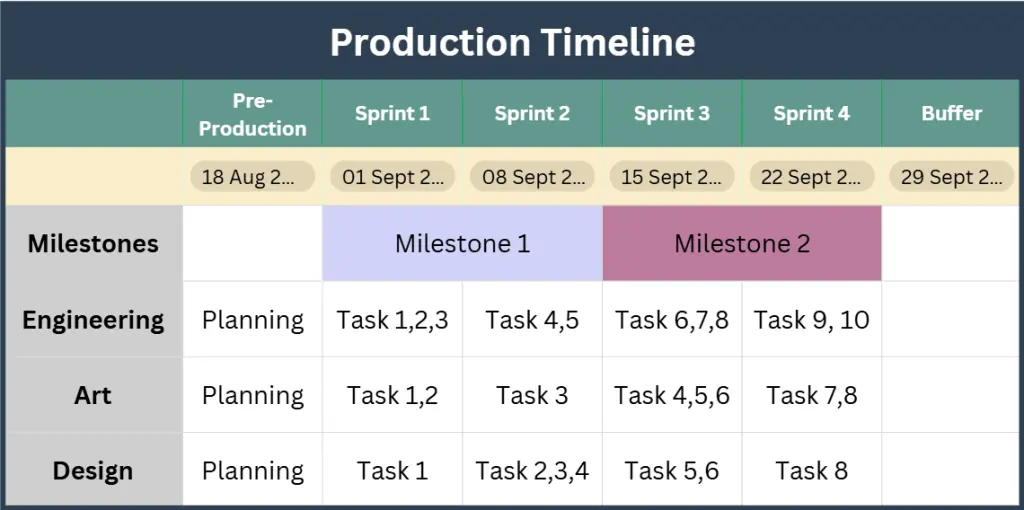
A mock version of a production timeline that shows separate milestones, shorter planning sessions throughout production, Buffer time and detailed tasks for each department.
Delays happen in every project. No matter how carefully you plan, things will slip. What separates smooth projects from chaotic ones isn’t whether delays happen, it’s how quickly you catch them and how effectively you adapt.
Here are a few lessons I’ve learned from my own experience as a producer.
1. Know Your Team and Customize Your Plan
One of the biggest advantages you can have as a producer is understanding how your team works best. Not every team responds well to the same planning style.
For example, if your team struggles with planning small details, then a single, large planning session at the start won’t work well. Instead, start with a general plan at the beginning then split the project into clear milestones. As you go, hold smaller, milestone-specific planning sessions each week as you get closer to implementation. This keeps planning relevant and digestible, while reducing the “guesswork” factor.
On the other hand, if your team can’t start working until they have a very clear picture and all the details laid out, then opt for a big detailed planning session during pre-production.
2. The Magical Two Weeks
When I first started as a producer, my mentor, Pit, introduced me to what he called the “magical two weeks.”
It’s essentially a hidden buffer, time no one knows about but you. For some projects it’s a few days, for others it might be up to a month. You never advertise this time to the team, to management, or to publishers. You use it only if the project is running behind schedule and you need a cushion to keep external commitments intact. This isn’t about encouraging sloppiness; it’s about being realistic about how unpredictable development can be.
3. Catching Delays Before They Become Disasters
Delays are normal, but how you react to them makes the difference between a project being 3 days late or 3 weeks late. To manage them effectively you must track tasks closely against their estimates.
If a feature is taking even a little longer than expected or agreed upon, the first step is to check in with the developer or artist responsible. If they need help or are facing unexpected issues, this is where you step in.
For example, if it’s a dependency issue, you can help by talking to all parties involved to find a solution that moves things along faster. However, if it’s an unresolvable situation (like a team member being sick or an unexpected, massive bug), note it for next time so you can build a better buffer.
After this initial check-in, you must still keep a close eye on the task to see if it goes back on track or if it is delayed further. If it is delayed further, act immediately. Again, depending on the situation, you can: re-scope the task, reassign resources, break the feature down further, or escalate the issue. The key is not to let a “minor delay” quietly snowball into something that derails the whole milestone.
Conclusion
No project runs without bumps. The producer’s role isn’t to prevent all delays — it’s to spot them early, adapt quickly, and keep the team moving forward while supporting and putting out fires where you can.